Case Study

Regulated Maritime Platform Modernization

84% Code Reduction: Regulated Maritime Platform Modernization from 14 Microservices to One

Services Rendered: Production Legacy System Engineering Production AI Platform Modernization

Platform modernization is rarely a choice. It is usually a consequence, of accumulated shortcuts, inherited complexity, and the slow realization that what once worked now holds everything back. For a leading maritime classification society operating a regulatory compliance SaaS platform across 5,500+ vessels worldwide, that realization came through seven workstreams of forensic assessment. The platform tracks emissions, fuel consumption, and regulatory obligations across eleven international frameworks. The operating environment is certified to SOC2 Type I and II and ISO 2700.

The Assessment

Tangled Dependencies Code Bloat Audit Exposure Imminent Deadlines

The company’s digital team was struggling to keep pace with the platform’s growing complexity. They brought in Tecknoworks to assess the entire digital products portfolio: three core applications across seven workstreams covering Architecture, Code Quality, Infrastructure and DevOps, Security, UI/UX, Data, and Product. Seven workstream leads spent weeks inside the codebase.

The assessment mapped the full landscape of accumulated technical debt, the natural result of five years of incremental development under shifting requirements. The platform had scaled beyond what its original architecture was designed to support. Test coverage had not kept pace with the platform’s growth, sitting well below the 80 percent industry benchmark. Code duplication had gradually exceeded acceptable thresholds, and inconsistencies had emerged across the stack: multiple database engines serving similar purposes, entities replicated across applications, and multitenancy handled differently in each one. None of it was unusual for a platform of this age and complexity, but left unaddressed, it was compounding.

Tecknoworks delivered a comprehensive assessment report in March 2025 with clear recommendations: consolidate to a modern architecture with shared services, unify storage and UI frameworks, integrate automated quality gates, deploy security monitoring for Zero Trust Architecture, and implement proper branching strategy with Blue-Green and Canary deployments. The roadmap was sound. But the client did not get a chance to follow it in order.

The Challange

Proving Under Fire

Before the client could act on the assessment recommendations, urgent delivery needs arose. Tough deadlines were approaching, EU regulatory enforcement for FuelEU Maritime and EU ETS 100 percent phase-in was imminent, and the existing engineering organization could not meet them. The client asked the Tecknoworks team, who now understood the platform intimately from the assessment, to help deliver.

The team scaled to approximately 14 people to fight fires across the platform. During this delivery work, the Tecknoworks engineers experienced the architectural mess firsthand. Not as assessors looking from the outside, but as engineers fighting it daily: the duplicated entities, the fragmented repositories, the brittle pipelines, the absent tests. Every deployment was painful. Every change rippled unpredictably. This phase earned the client’s trust and deepened the team’s understanding of what actually needed to change at the root.

The Solution

Double or Nothing

Having lived inside the complexity and earned the client’s trust through urgent delivery, Tecknoworks proposed something radical. Rather than incrementally patching the platform while continuing to fight fires, they would rebuild its foundation. The pitch was simple and carried real conviction: “If you’re not happy with what we do in five weeks, you pay nothing.”

The client agreed. A three-person team was assigned to the modernization sprint.

In five weeks, that team delivered a complete platform transformation. The 14 separate repositories were merged into two clean monorepos with clear boundaries between frontend and backend concerns. The backend was reduced from 205,000 lines to 69,000 lines, a 66 percent reduction, while simultaneously expanding its capabilities. Rather than patching the existing UI, the team wrote 77,000 lines of modern frontend code from scratch.

The 89 legacy pipeline files were replaced with six automated pipelines. The team wrote Bicep Infrastructure as Code templates that deploy the entire Azure environment, eight services in total, with a single command: App Service, Static Web App, SQL Server, Cosmos DB, Blob Storage, a PDF generation engine, monitoring infrastructure, and identity management.

Eleven maritime regulatory calculators were built, tested, and validated. The team built 156 API operations covering every workflow in the platform, each with automated test coverage. The modernized platform included features the legacy system never had: an AI-powered Pool Optimization Engine, CII projection tools for forward-looking compliance planning, real-time notifications for regulatory threshold alerts, and automated fuel consumer creation.

The contrast was stark. Fourteen people had been fighting fires across a fragmented platform. Three people solved the root cause.

The Outcome

Trust & Partnership

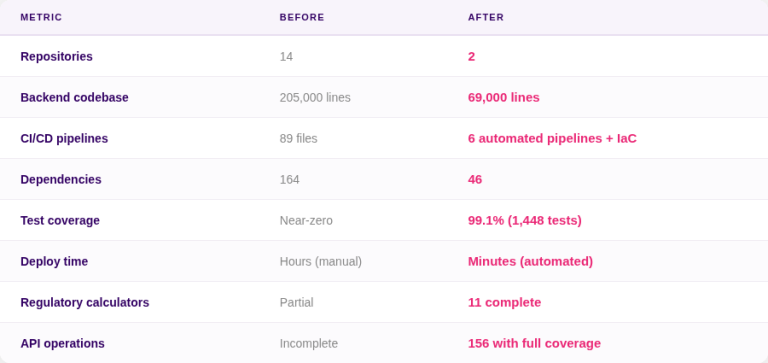
The numbers tell the story clearly. Test coverage went from zero to 99.1 percent, with 1,448 automated tests covering all 156 API operations. Third-party dependencies dropped from 164 to 46, a 72 percent reduction in supply chain risk. Deployment time went from hours of manual intervention to minutes with a single command. The codebase became two-thirds smaller and more capable.

Beyond the metrics, the modernized platform launched ahead of multiple competitors, protecting a significant multi-year revenue opportunity for the client in the FuelEU compliance market.

Platform Modernization Results At a Glance:

What took an entire engineering team months to hold together, three engineers rebuilt in five weeks.

The architecture that once demanded seventy-minute deployments and coordination across a dozen pipelines now ships in minutes with a single command.

The numbers below capture the full scope of that transformation, not just what shrank, but what grew: test coverage, reliability, and the team’s ability to move fast without breaking things.

Platform modernization before and after metrics — maritime compliance case study

Why This Engagement Matters

A story about progression

This case study is not a story about engineering velocity, though the velocity was exceptional. It is a story about a progression that cannot be faked: assessor, firefighter, architect, partner.

The assessment gave Tecknoworks diagnostic credibility. The delivery under fire gave them operational trust. The “double or nothing” sprint gave them proof of conviction. Not just capability, conviction. Offering to work for free if the client was not satisfied is not a sales tactic. It is what a team does when they have seen the root cause, know they can fix it, and are willing to bet on themselves.

The most telling detail is the contrast between the two phases. Fourteen people fighting fires could not keep the platform stable. Three people solving the root cause rebuilt it entirely. That is not a story about headcount. It is a story about understanding the real problem versus treating symptoms.

The client’s decision to make Tecknoworks their permanent engineering partner did not come from a proposal. It came from watching the same team who assessed their platform, who fought alongside them under pressure, and who then bet their own fees that they could fix it. That kind of trust is earned in sequence, not manufactured.

Technology:

 .NET GraphQL Azure Bicep Infrastructure as Code CI/CD Pipelines PDF Generation Engine, Real-time Notifications AI-powered Pool Optimization

Our Success Stories

Discover client success stories and use cases, covering extensive topics, including next-gen technologies, data analytics, automation processes, and more.

AI Delivery Squads

Need ongoing capacity? Our engineers embed in your organization and ship production AI continuously. Not a consulting rotation. A dedicated team aligned to your mission, operating inside your systems.