
Multi Agent Systems in Artificial Intelligence Reinventing Business Operations
At Tecknowork, our exploration of multi agent systems (MAS) in artificial intelligence has revealed transformative potential for business operations.
At Tecknowork, our exploration of multi agent systems (MAS) in artificial intelligence has revealed transformative potential for business operations.

At Tecknowork, our exploration of multi agent systems (MAS) in artificial intelligence has revealed transformative potential for business operations.
These systems deploy teams of specialized AI agents that collaborate to automate complex workflows with unprecedented efficiency and scalability. By mirroring human organizational structures while leveraging AI’s computational power, MAS enable businesses to achieve new levels of operational excellence.
At their core, multi agent systems in artificial intelligence represent a paradigm shift in how we deploy AI in business environments. Rather than relying on a single, general-purpose AI to handle complex workflows, multi agent systems deploy multiple specialized AI agents, each responsible for one specific task in a larger process. This approach to artificial intelligence architecture enables more sophisticated, resilient, and efficient automation of complex business processes.
This approach mirrors how human teams operate in the workplace, with specialized roles, clear handoffs, and coordinated workflows, but with the added benefits of AI: scalability, consistency, and 24/7 operation capabilities.
To test the real-world potential of multi-agent systems in artificial intelligence, we built a virtual sales prospecting team comprised of four distinct AI agents working together.
This agent identifies potential customers and researches them online. It gathers information about company size, industry, recent news, pain points, and current solutions they might be using.
Armed with deep knowledge of our services, past projects, and capabilities, this agent analyzes the research and identifies how our offerings align with the prospect's specific needs and challenges.
Using the detailed input from the first two agents, this specialist crafts highly personalized outreach emails that speak directly to the prospect's situation and clearly articulate our value proposition.
The orchestrator manages the entire workflow, ensuring the right handoff happens at the right time. When the Researcher completes its task, the Orchestrator transfers that information to the Solution Matcher. Once the matching process is complete, it activates the Communication Specialist to craft the final message.
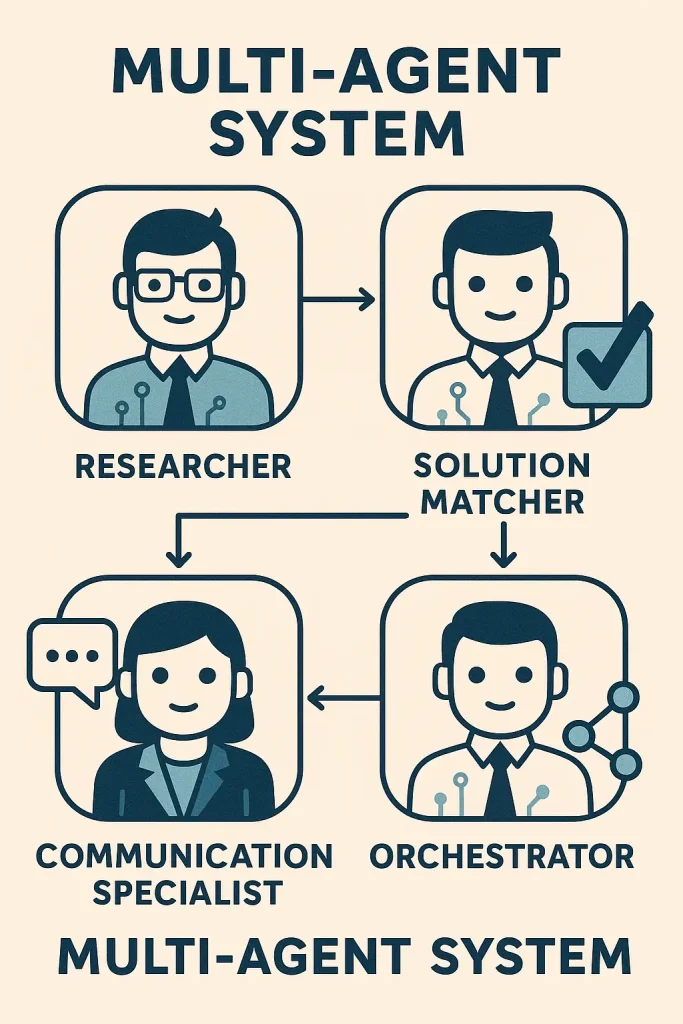
This approach to AI implementation mirrors how most organizations already operate. In traditional business environments, teams of people handle different aspects of a process, with each person responsible for their specialized domain.
Multi-agent systems in artificial intelligence essentially digitize and optimize this organizational structure, creating a more efficient digital workforce that can operate in parallel and at scale. Unlike traditional AI approaches that focus on single, monolithic solutions, multi-agent architectures offer several key advantages:
● Tasks get divided into clear, manageable steps.
● Each step is handled by a specialized agent optimized for that specific function.
● The overall process becomes faster, more consistent, and infinitely scalable
Will every business task eventually be handled by AI?
Not in the near future.
Human oversight, what we call “human-in-the-loop”, remains essential for:
● Validation of outputs
● Nuanced judgment calls
● Strategic decision making
● Handling exceptions and edge cases
However, as these AI systems evolve and improve, they will gradually become more autonomous, eventually handling entire processes end-to-end, particularly for well-defined, repeatable workflows.
Successfully implementing multi-agent systems in artificial intelligence requires a methodical approach that balances technical capabilities with business process understanding:
Before you can automate a workflow, you need to thoroughly understand it. Document your current operations in detail.
Identify the distinct steps and decision points in your process. The more clearly defined each component is, the better.
Identify the parts that are well-defined, rules-based, or pattern-recognition focused, that are suitable for AI automation.
This methodical deconstruction and optimization of workflows becomes your intellectual property—your competitive advantage in an AI-powered future. The ability to effectively implement multi-agent systems in artificial intelligence will increasingly differentiate market leaders from followers.
We’re continuing to refine our multi-agent systems in artificial intelligence and explore new applications beyond sales prospecting. The research in this field is advancing rapidly, with new frameworks, communication protocols, and reasoning capabilities emerging regularly. The potential applications of this technology span virtually every business function:
● Customer support and service
● Content creation and marketing
● Project management
● Supply chain optimization
● Product development
… And much more
The question isn’t whether multi-agent systems in artificial intelligence will transform business operations, but how quickly organizations will adapt to this new paradigm.
For those considering implementing multi-agent systems in artificial intelligence within their organization, several technical considerations come into play:
1. Agent Communication Protocols: Determining how agents will exchange information effectively and securely
2. Conflict Resolution Mechanisms: Decide how to handle competing priorities or conflicting recommendations between agents
3. System Architecture: Designing the overall structure that allows for both independence and collaboration between agents
4. Security and Monitoring: Implementing appropriate safeguards to ensure agents operate within established parameters
Many organizations are finding that starting with smaller, focused implementations of multi-agent systems allows them to build institutional knowledge and confidence before scaling to more complex processes.
Multi-agent systems in artificial intelligence can be incredibly powerful and may even remove the need for human middlemen between tasks. They represent not just an efficiency boost but a fundamental rethinking of organizational structure and business process execution.
In our view at Tecknoworks, this is where the future of work is heading. Organizations will increasingly be built around these intelligent, specialized multi-agent systems in artificial intelligence, with humans focusing on oversight, exception handling, creative problem-solving, and strategic direction.
October 14, 2026
Software engineering stopped being about writing code. It became about managing context.
Read article
July 20, 2026
Every week I filter roughly 15 AI newsletters down to what matters for production teams.
Read article
July 13, 2026
This week had one theme: fracture. Three frontier labs shipped models in 72 hours.
Read article
July 7, 2026
Eighteen days without a frontier model is a long time when your production systems depend on it.
Read article
July 1, 2026
This was the week everyone stopped fighting over AI intelligence and started fighting over AI control.
Read article
June 22, 2026
This was the week the platforms stopped talking about AI and shipped infrastructure for it.
Read article
June 15, 2026
This week had one theme: the sovereignty fracture.
Read article