DOWNLOAD THE STUDY
Artificial Intelligence (AI) has rapidly become a cornerstone of modern business strategy, providing companies with unparalleled opportunities for growth, efficiency, and innovation. A recent study by Microsoft and IDC sheds light on the substantial economic benefits of AI adoption and offers a comprehensive overview of its transformative potential across various industries.
Key findings from this study show:
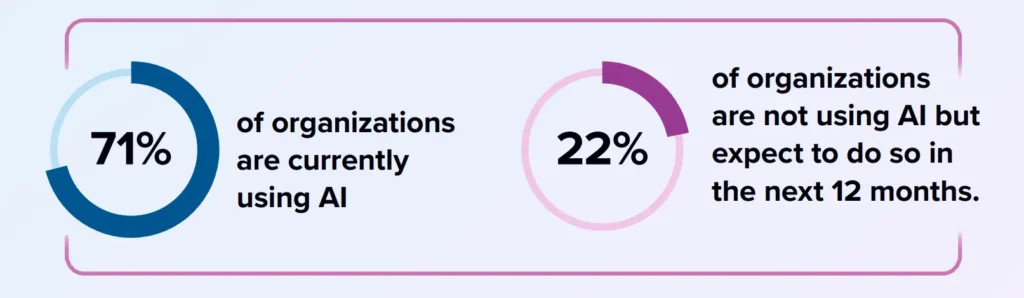
● 71% of respondents say their companies are already using AI
● 92% of AI deployments are taking 12 months or less
● Organizations are realizing a return on their AI investments within 14 months
● For every $1 a company invests in AI, it is realizing an average return of $3.5X
● 52% report that a lack of skilled workers is their biggest barrier to implementing and scale AI .
 DOWNLOAD THE STUDY
● High Adoption Rates and ROI
According to the study, an impressive 71% of companies have already implemented AI in some capacity. This widespread adoption is driven by the promise of significant returns on investment (ROI), with most companies seeing these returns within just 14 months. The speed and scale of these returns underscore the immediate financial advantages of integrating AI into business operations.
● Enhancing Employee Productivity
AI is revolutionizing the workplace by enhancing employee productivity. Through automation of routine tasks and the provision of advanced data analytics, AI enables employees to focus on higher-value activities. For example, AI-powered tools can automate customer service responses, freeing up human agents to handle more complex queries. This improves efficiency and enhances job satisfaction by allowing employees to engage in more meaningful work.
● Improving Customer Engagement
Customer engagement has also seen significant improvements due to AI. Personalized recommendations, predictive analytics, and conversational AI are just a few examples of how businesses leverage AI to enhance customer experiences. These technologies help companies anticipate customer needs, provide tailored solutions, and maintain a competitive edge in a crowded market.
● Optimizing Business Processes
AI’s impact on business processes cannot be overstated. From supply chain management to financial forecasting, AI systems optimize operations and drive better decision-making. By analyzing vast amounts of data in real-time, AI can identify inefficiencies and recommend solutions that traditional methods might miss. This results in more agile and responsive business operations.
● Addressing the Skills Gap
Despite these advantages, the study highlights a significant barrier to further AI adoption: the lack of skilled workers. There is a growing demand for professionals proficient in AI technologies and capable of leveraging them effectively. Companies must invest in training and development programs to bridge this skills gap and fully realize the potential of AI.
In Perspective
The Microsoft and IDC study findings clearly illustrate AI’s business value. Companies embracing AI can expect substantial improvements in productivity, customer engagement, and operational efficiency. However, addressing the skills gap remains a critical challenge that must be tackled to unlock AI’s potential fully.
Read the full Microsoft study for a deeper dive into these insights and to understand the broader implications of AI in business.